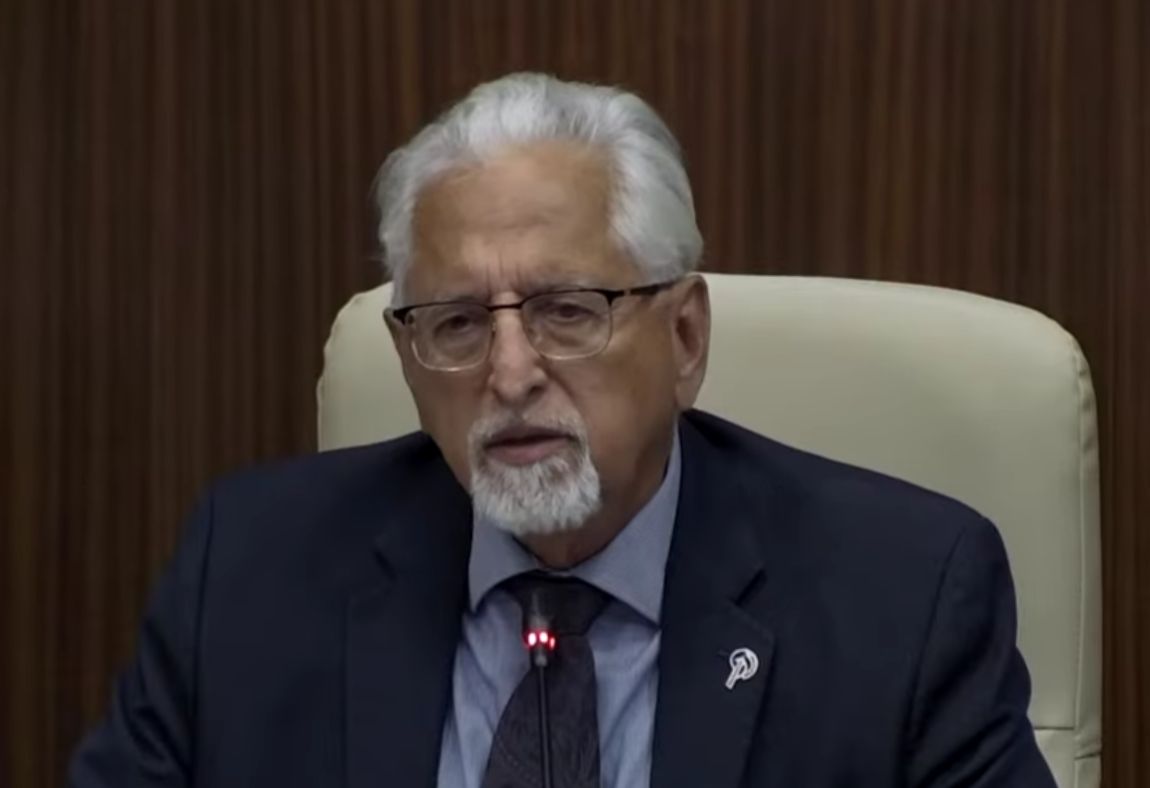
The Richmond City Council’s Tuesday night meeting was dominated by the fallout from Mayor Eduardo Martinez’s social media activity. Over four hours of the five-and-a-half-hour session were dedicated to debating the mayor’s decision to repost conspiracy theories related to a terrorist attack on a Jewish Hanukkah festival in Australia, along with other antisemitic content.
Ultimately, Martinez avoided a formal censure. In a 6-1 vote, the council majority, including the mayor and his Richmond Progressive Alliance (RPA) allies Doria Robinson, Claudia Jimenez and Sue Wilson, approved a resolution for voluntary antisemitism training instead. The vote postponed the official rebuke of the mayor indefinitely. Councilmember Jamelia Brown, the lone dissenting voice, denounced the move as “coward behavior” shortly before the meeting adjourned.
Brown argued the resolution was designed to help the mayor avoid a recorded vote of condemnation, telling her colleagues they should be ashamed for “checking off boxes” instead of standing in solidarity with those harmed.
Tyler Gregory, CEO of the Jewish Community Relations Council (JCRC) of the Bay Area, echoed this, calling the decision “a failure of leadership” and a “strategic move to shield a political ally rather than to hold an elected official accountable for spreading dangerous and hateful conspiracy theories.”
In a statement, the JCRC said it “continues to believe Mayor Martinez must resign.”
“The mayor did not provide genuine acknowledgment of harm in his public comments, which took place more than a month after his latest antisemitic posting was discovered,” the organization stated in a social media post today. “We are grateful that Temple Beth Hillel has agreed to work on restorative steps with the mayor, though we remain rightfully skeptical of his intentions due to his continued disappointing conduct.”
Public backlash
The nature of the mayor’s apology was among the public criticisms. Before reading from an apology letter at Tuesday’s council meeting, he lamented the difficulty of making amends to a divided public. He explained that a message satisfying one group often fails to resonate with another, leading to a cycle of “apology after apology” in a futile attempt to meet everyone’s differing expectations.
“It’s difficult to apologize, not because one is insincere, but because there are people who are not ready to accept an apology,” he said.
Several residents dismissed the gesture as insincere. Jewish resident Levi Clancy told the mayor his words were inadequate compared to the harm caused by spreading dangerous claims. Resident Stephen London slammed the restorative justice plan as “hollow” and “the bare minimum for damage control.” The mayor and his supporters cited a period of illness as the reason for the posts, an excuse London described as “ludicrous.”
Another member of the public, Rachel Biden, said the mayor’s “hate runs so deep that you couldn’t even keep it inside like a sane person.”
“Even KKK members are smart enough to keep their views out of their office place,” she said.
Background
The calls for accountability stem from a pattern of social media activity that the Jewish community describes as dangerous. The most recent incident involved the mayor reposting a “false flag” conspiracy theory suggesting the Sydney massacre was staged.
In early 2025, Mayor Martinez faced backlash for a speech at the People’s Conference for Palestine in Detroit, where he likened the Oct. 7 Hamas attack to himself as a child reacting to a schoolyard bully.
Community leaders also pointed to the mayor’s history of posts regarding Jewish holidays. Specifically, the mayor faced criticism for posts appearing to erase the Jewish connection to Israel during Hanukkah—an act Rabbi Julie Saxe-Taller of Temple Beth Hillel described as “deeply irresponsible.” Regional leaders, including the JCRC, argue these posts are part of a years-long pattern of spreading tropes that make Jewish residents feel physically unsafe.
Desire for focus on city issues
This marathon debate highlights a consistent trend where the Richmond Progressive Alliance (RPA)-led council prioritizes international activism over the city’s immediate local needs. In 2023, Richmond gained national attention as the first U.S. city to pass a resolution regarding the Gaza-Israel conflict, an action that consumed hours of public session time.
The council’s global focus continued into May 2024 with a vote to divest city funds from companies linked to Israel, followed by the August 2025 establishment of a sister-city relationship with Sebastia, a Palestinian town in the West Bank. Furthermore, the council frequently devotes its limited session time to resolutions urging an end to the U.S. embargo of Cuba.
“It is deeply frustrating to sit here hour after hour while our city’s actual needs are sidelined,” said resident Elizabeth Gracetti. “We are talking about posts regarding Australia and the Middle East when our own roads are crumbling and our small businesses are struggling to stay open.”
Fellow resident Stephanie Gwyn added, “This isn’t just about a post; it’s about a pattern of behavior that takes us away from the work we need to do.”
“When the leadership spends their energy on ‘false flag’ theories and international posturing, the people of Richmond suffer,” Gwyn said. “We are essentially normalizing a culture where international activism is more important than whether our streets are safe or our city is financially stable. A years-long pattern of conspiratorial posts cannot be erased by a few private meetings or a training session that feels more like a political shield than actual accountability.”