By Mike Aldax
Class was in session at CoBiz Richmond Thursday, Dec. 11, as Chevron Richmond employees and independent air-quality experts instructed community members on how the refinery’s air-monitoring system works, including how to access and interpret the real-time data themselves at richmondairmonitoring.org.
Chevron Richmond hosted the meeting to explain its fenceline and community air monitoring system, a network of instruments that measures ambient air quality around the refinery and in nearby neighborhoods 24 hours a day, seven days a week. The evolving system meets Bay Area Air District Rule 12-15 requirements and is operated by independent third-party experts at Sonoma Technology, with data publicly available online.
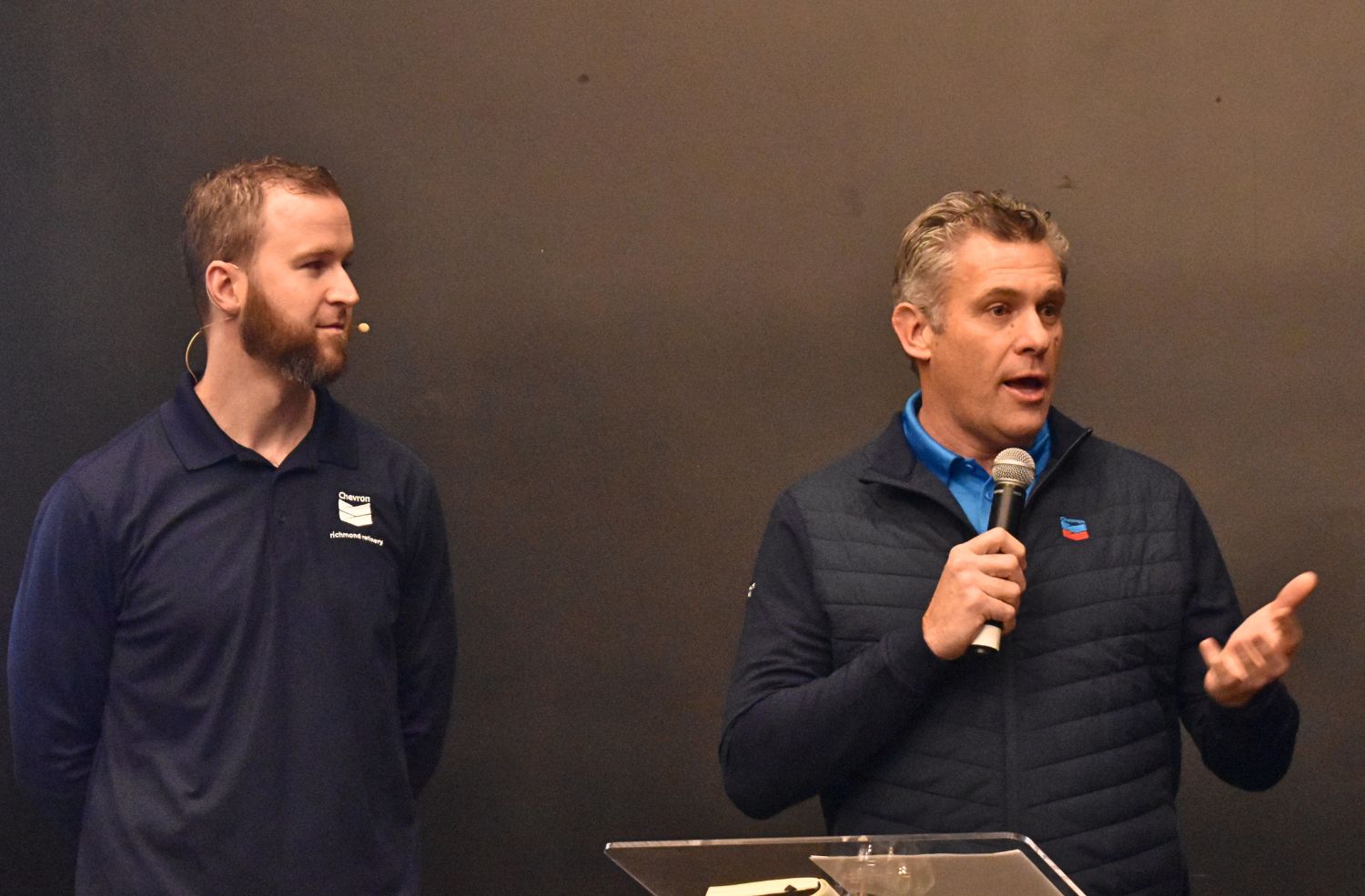
“Our monitors measure ambient air quality, which can be impacted by a number of things, including local sources like trucks, wood smoke, other industry, and also pollution brought in from other areas by weather conditions, such as wildfire smoke,” said Luke Honnen, environmental air specialist at Chevron Richmond.
The system was installed in 2013 and continues to evolve. Under a June 2025 agreement with the Air District, Chevron Richmond has been expanding access to air-quality information and working to make it clearer and more useful for the public. That includes expanding downloadable historical data, making additional data formats available, and hosting a community meeting to gather feedback.
“Starting in October 2025 going forward, we have five years of data available for download instead of three months,” Honnen said.
He noted Chevron Richmond is the first refinery to reach an agreement with the Air District on its air monitoring plan, which he called “a good thing for all involved.”
How the monitoring works
At the Dec. 11 meeting, Chevron and Sonoma Technology representatives explained how air-quality data is collected, analyzed and posted online. Sonoma Technology Air Measurements Department Manager Maris Densmore described the system as a combination of technologies working together in real time.
“It is my team of data analysts and instrument technologists and field technicians and project managers and web developers and atmospheric chemists that all come together to build this system and make sure that it’s running optimally,” Densmore said.
‘As you use these new tools and resources, we really want feedback. That’s how we continue to improve how the data is shared.’
The system uses open-path monitors, which send beams of infrared and ultraviolet light across open air, as well as point monitors that measure specific compounds at fixed locations. Additional sorbent tubes are used to track benzene over longer periods.
“What happens is, when you shoot [the light] through the air, you’re able to determine what is in that air between where you’re shooting that beam and where you pick it up,” Densmore explained. “It’s tuned for the specific chemicals and compounds that are required in [Air District] regulation.”
Once measurements are taken, the data goes through automated quality checks before being posted online, typically within minutes.
“Our goal is to get it there within five minutes or so, definitely under 10 minutes,” Densmore said.
Website updates and public access
Sonoma Technology staff demonstrated updates to the monitoring website, including a “neighbor notice” banner (see following image) that turns green when all measured compounds are below health-based limits and orange if a threshold is exceeded.
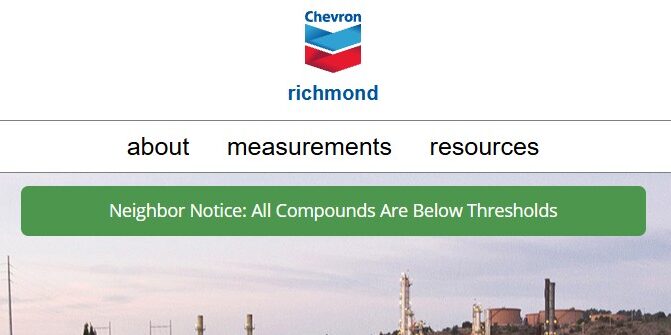
“When you log into the website, you’re immediately able to see what’s going on,” Densmore said. “If it’s green, you know right away that all the compounds we’re looking for are below the applicable limits.”
The website also includes color-coded graphs, plain-language explanations of monitored compounds, links to health information and tools for downloading data in multiple formats.
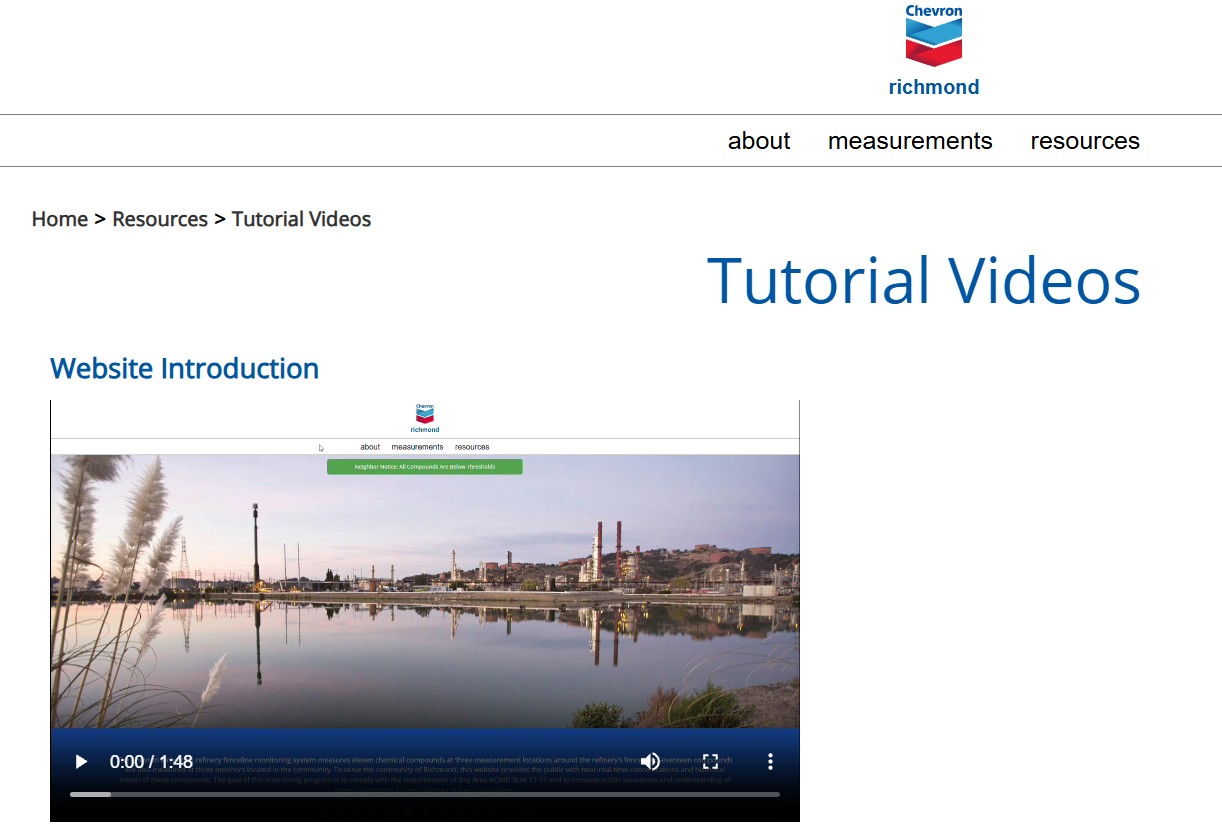
Neil Fernandez, Sonoma Technology’s project manager, walked attendees through the site’s public data download tools, including an application programming interface that allows users to pull real-time or historical measurements by location, date and compound and a page of tutorial videos to help improve accessibility.
“As you use these new tools and resources, we really want feedback,” Fernandez said. “That’s how we continue to improve how the data is shared.”
Public feedback continues
The Dec. 11 meeting was among the requirements of Chevron Richmond’s 2025 agreement with the Air District, but the company said outreach around air monitoring and refinery operations will continue.
Written public comments on the monitoring program are being accepted through January at this link, and a summary of community feedback and Chevron’s responses is expected to be published by March 2026.