At the second Community Action Plan (CAP) town hall meeting, Chevron Richmond employees announced the pursuit of several significant environmental initiatives aimed at cutting emissions, expanding renewable energy, and improving flare performance.
The event, held as part of the 2024 settlement agreement with the Bay Area Air District (BAAD), provided updates on the permitting process for a wet gas scrubber at the facility’s fluid catalytic cracking unit. In addition, a 15-megawatt floating solar array is planned for construction on unused refinery land.
The town hall meeting also provided a progress report on flaring incidents and detailed an automated monitoring system called Flare.IQ. The advanced technology collects and assesses data on refinery processes in real time and adjusts accordingly to ensure flares burn more efficiently and cleanly, leading to fewer emissions.
According to Brian Hubinger, senior manager of public and government affairs at Chevron Richmond, installation of the wet gas scrubber will enable the refinery’s processing unit to meet “the most stringent particulate matter standards in the country, if not the world.” The device is currently in the permitting phase and will undergo community review before installation begins, he said.
“This is a major investment for Richmond,” Hubinger said.
The 15-megawatt floating solar array will be constructed on underutilized land within the refinery. It builds upon the success of the existing 10.5 MW MCE Solar One system that is already operating on a different section of the refinery.
“The floating solar array will help offset the refinery’s electricity use and lower our overall emissions,” Hubinger said.
Hubinger also announced that Chevron Richmond will contribute $20 million towards a Community Air Quality Fund, per the settlement with the BAAD. The fund, which will be managed by BAAD (Community Benefits: English, Spanish), will support projects and programs that reduce PM emissions from other sources in and around the Richmond area.
Progress on flaring
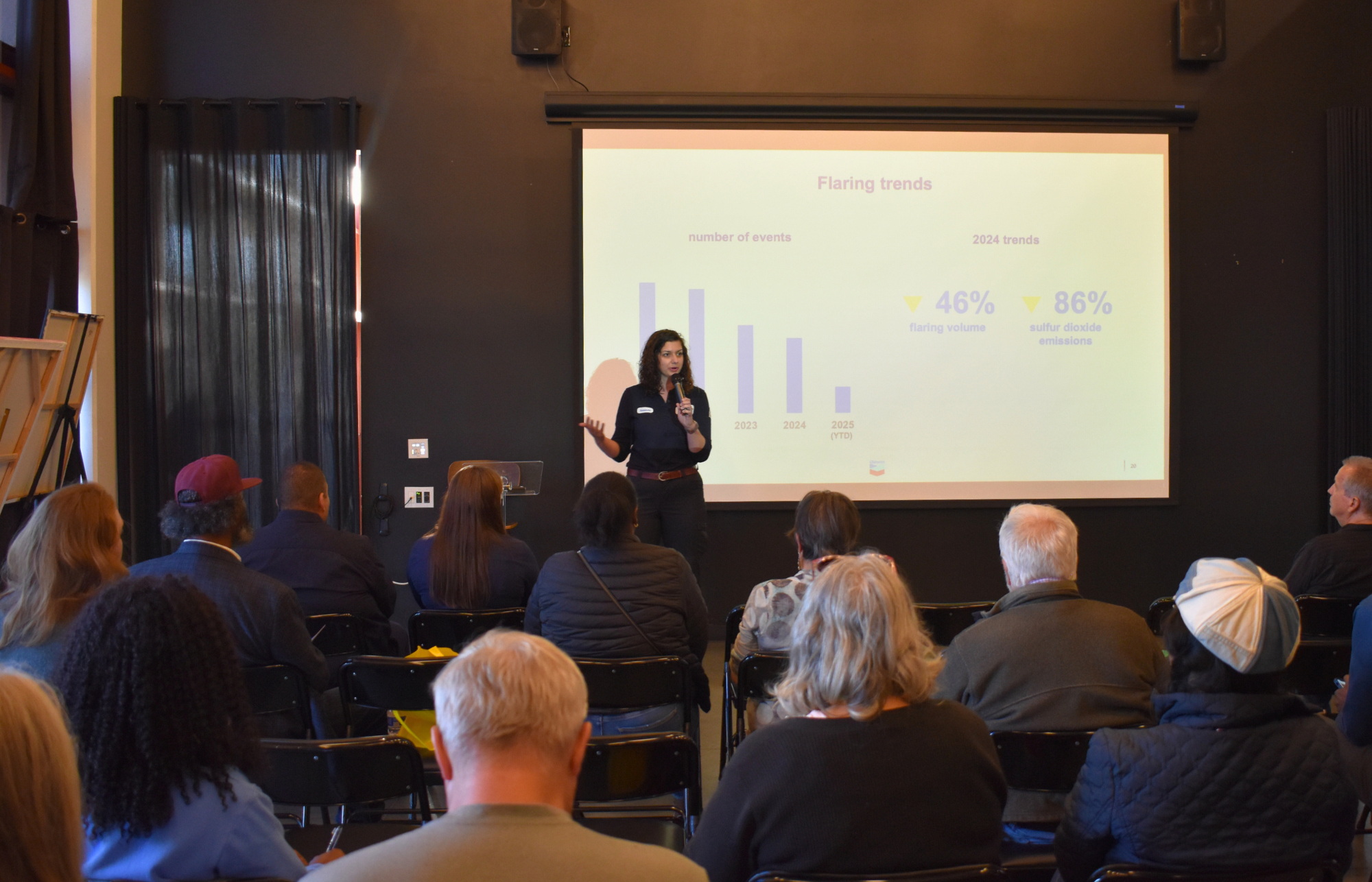
At the CAP meeting, which aims to create a spirit of transparency and communication between the company and community, Chevron Richmond Operator Trainer Israel Leon, Engineer Amanda Hernandez and Environmental Specialist Katie Rodriguez provided information on the purpose of flaring devices as a safety mechanism, data on recent and historical flaring performance, and compliance with BAAD regulations.
Hernandez reported a 46 percent reduction in total flaring time and an 86 percent decrease in sulfur dioxide emissions over the past five years. The success can be attributed to technological upgrades, enhanced operator training, procedural updates, tens of millions of dollars in investments, and dedicated flare response teams responding to incidents. She also noted a series of flaring incidents this past February that were “each triggered by a different mechanical failure.” She added that none of those failures were repeated, “showing we’re learning from every flare.”
Focus on community engagement
The town hall was guided by Dr. Kirby Lynch, a community facilitator with roots in Richmond and a deep background in environmental policy. Lynch expressed a hope that the meeting could serve as a space for honest dialogue.
“This process was borne out of community demand for truth, accountability, and a real seat at the table,” said Lynch. “We’re not promising overnight transformation, but we are promising transparency and the power of collective problem-solving.”
Lynch emphasized the role of the Community Action Plan Committee—a group of residents and neighborhood leaders from nearby areas like North Richmond, Parchester Village, Santa Fe, and the Iron Triangle—in shaping communications with Chevron Richmond.
Residents were encouraged to visit RichmondAirMonitoring.org, where they can view their air quality in real time from data pulled from dozens of monitors located throughout the community.
Also at the CAP meeting, Caitlin Powell, external communications advisor at Chevron Richmond, shared information with community members about the Contra Costa County Community Warning System, which keeps provides important updates during emergencies, whether at the refinery or anywhere else in the county. Powell encouraged residents to sign up for County awareness messages by texting “CCHealth” to 21423 and community action alerts byr visiting CWSalerts.com.
Emissions contextualized
Hakim Johnson, public affairs representative at Chevron Richmond, contextualized local emissions, noting that only 6 percent of airborne pollutants in the Richmond-San Pablo area come from industrial point sources like refineries, citing air monitoring data collected from the state’s Community Air Protection Program via Assembly Bill 617.
“The majority of emission exposures are from regional sources like wildfires, traffic, and residential wood burning,” Johnson said, pointing to real-time air monitoring data.
Still, Johnson acknowledged that flaring and emissions remain a local concern.
“Even if it’s a small percentage, it’s visible. It’s personal,” he said. “And that’s why we’re working to reduce it further.”
Building trust through participation
Residents attending the CAP meeting were encouraged to provide feedback, ask questions, and participate in breakout sessions to shape future CAP priorities. Hubinger reiterated Chevron’s openness to criticism and improvement.
“We’re a company of engineers—we think we’re explaining things clearly. But if something doesn’t make sense, tell us. And we’ll try to do better,” he said.
The CAP process is intended as a long-term framework for improving safety, air quality, and accountability.
“We want to hear from you. We want you to hear from us,” Hubinger said. “This is an organic process that is being shaped by meetings like this.”