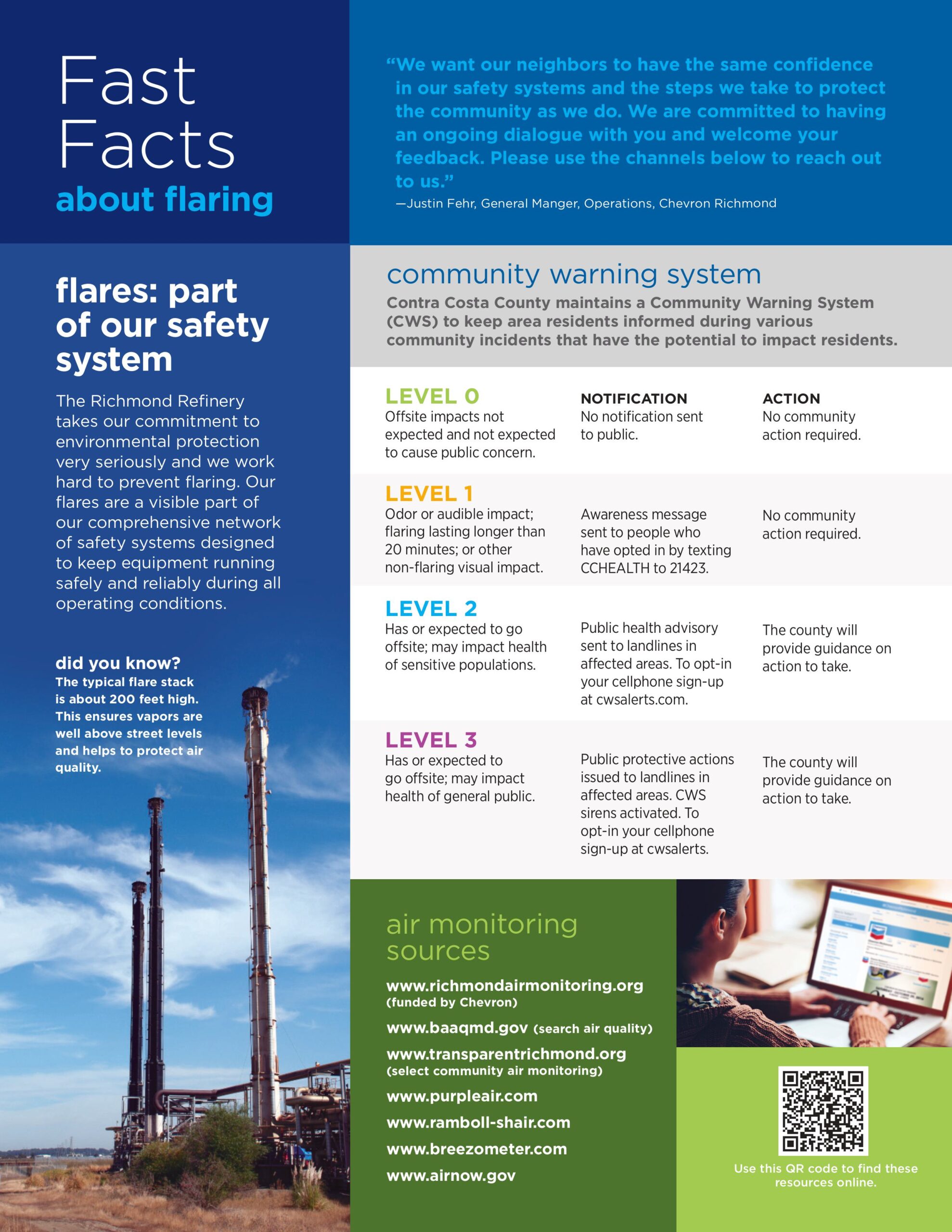
Last month updates were made to the Community Warning System (CWS), an important and expanding resource that keeps residents informed of any potential health hazards or emergencies that occur in Contra Costa County.
The CWS is an “all-hazard” public warning system that provides landline, text, email and media alerts to members of the community. The system is a partnership involving the Office of the Sheriff, Contra Costa Health, other government agencies, industry, news media and the non-profit Community Awareness & Emergency Response (CAER) organization.
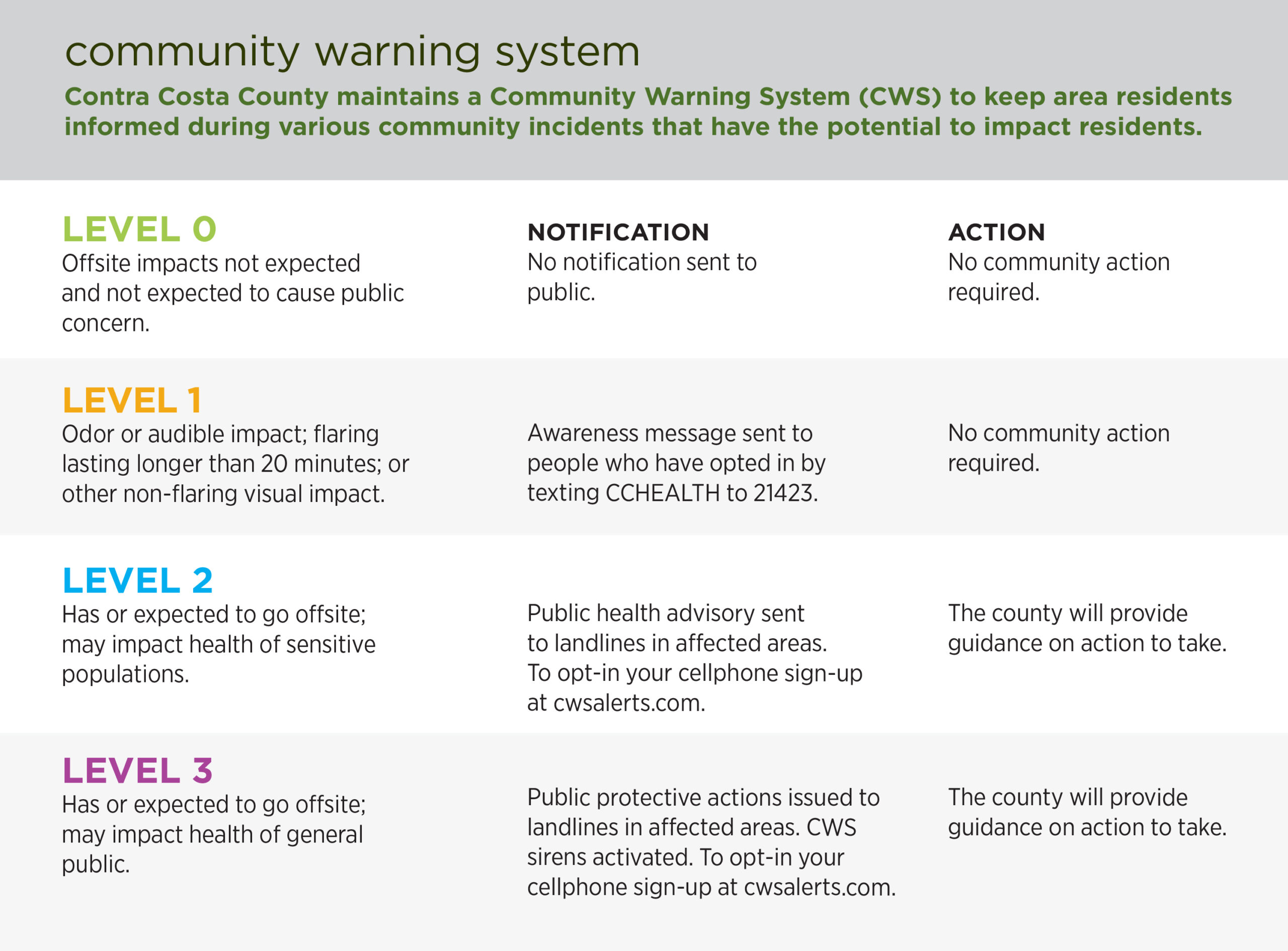
The CWS system covers incidents at industrial facilities, including the County’s four refineries. Alerts come in four levels based on an incident’s potential impact on the community. CWS Level 0 and Level 1, for example, involve no expected community impact, while a CWS Level 3 will likely advise all residents in the affected area to shelter-in-place while providing public notification to all landlines, and to registered cellphones.
On Feb. 1, a fire at the Martinez Refining Company (MRC) fire prompted a Level 2 and a subsequent Level 3 notification to residents north of the refinery. The alert instructed residents to remain indoors with closed windows and doors, to deactivate all heaters, fans and air conditioners, and the CWS sirens were sounded.
In the case of recent flaring at Chevron Richmond, a CWS Level 0 and Level 1 notification was issued to keep the community informed, however, no action was required.
While the sight of flaring can cause concern in the community, it is actually a visible sign that the refinery’s safety systems are working as designed. A refinery’s flare systems burn pollutants to prevent them from being released directly into the atmosphere. They work like gas stoves in homes, equipped with a pilot light or an ignitor at the top that ignites when you turn on the gas. The typical flare stack is about 200 feet high, which ensures the combustion takes place well above street levels to protect air quality in the community.
Flaring can occur for reasons that include a loss of power, changes in pressure or temperature, equipment failure or excessive vibration. Chevron recently noted that flaring may also occur during routine or planned maintenance activities while operators are working to safely restart processing units.
Whether visible incidents at a local facility prompt a Level 1 awareness notification or an actionable Level 3 alert, the CWS exists to keep local agencies and community members informed and prepared to act. Now, residents can opt in to receive awareness messages related to Level 1 notifications throughout the County.
“Timely communication is critical when it comes to hazardous materials incidents,” said Nicole Heath, Director of CCH’S Hazardous Materials Program. “By introducing Level 1 community awareness messages, we’re giving residents an additional layer of information to stay aware.”
Residents can sign up for free to receive actionable alerts (Level 2 and Level 3) on their cellphones at cwsalerts.com. In order to receive the new CWS alerts for Level 1 notifications, residents must opt-in to a separate system by texting CCHEALTH to 21423.
For more information related to these topics, check out the resources included on the Chevron Richmond, CAER and Contra Costa Health websites. Residents are also encouraged to follow @chevronrichmond and @RFDCAOnline on Facebook and X (formerly Twitter), where additional information may be posted during an incident.