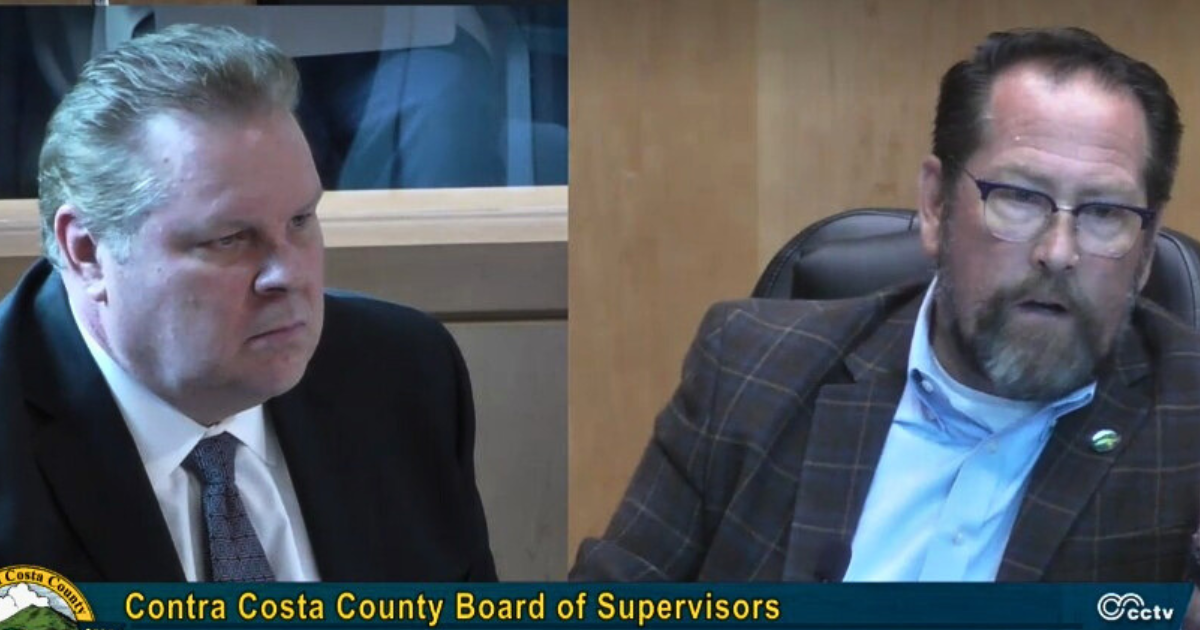
Contra Costa County leaders, immigrant rights advocates, and law enforcement officials debated at a public forum Tuesday whether the county should continue notifying federal immigration authorities about certain individuals in custody, and whether local agencies should intervene to prevent U.S. Immigration and Customs Enforcement (ICE) from conducting raids.
Held annually under California’s Truth Act, the forum drew unusually high public participation amid heightened federal immigration enforcement under the Trump Administration. The meeting featured presentations from the County Administrator’s Office, the Immigrant Legal Resource Center (ILRC), and Contra Costa Sheriff David Livingston, followed by questions from supervisors and nearly 50 public commenters.
Sheriff Livingston reported that his office received 578 ICE notification requests in 2024 and responded to 96, or roughly 17 percent. He emphasized that only individuals with prior convictions for serious or violent felonies were subject to notification, and that the sheriff’s office does not assist in detainers or transfers, nor does it allow ICE to conduct interviews inside jail facilities.
Livingston stated that compliance with notification requests follows state law, including the California Values Act (SB 54), and that the department does not ask about or track immigration status.
However, legal advocates and some county supervisors questioned whether these notifications, even if technically legal, were consistent with the county’s values or the spirit of state law. An ILRC attorney said ICE cooperation remains discretionary and warned that even limited collaboration can erode trust in law enforcement, deter crime reporting, and lead to deportations based on minor offenses or legal misinterpretations. The attorney argued there are offenses being flagged that may not meet the notification criteria under SB 54, and warned of the risk of not only error but also of liability for the county.
Differing interpretations
Supervisors also questioned whether individuals flagged for ICE notification were truly limited to serious or violent offenders and pressed for clarification on offenses classified as “wobblers” — crimes that may be charged as either misdemeanors or felonies.
Sheriff Livingston and his command staff said notifications are made only after detailed review of rap sheets and prior convictions, including instances where past felony convictions make certain misdemeanors eligible for notification. He defended the department’s compliance with state law and said the office was open to dialogue but unwilling to stop notifications for individuals convicted of serious crimes.
Public Defender Ellen McDonnell urged the board to adopt a policy ending all ICE notifications, stating that even experienced attorneys struggle to interpret criminal histories under SB 54’s narrow exceptions.
“This is a due process issue, a racial justice issue, and a legal liability risk for the county,” McDonnell said.
Limited oversight
County Counsel clarified that the Board of Supervisors cannot directly control the sheriff’s operational decisions, though it does have budgetary authority. Supervisors acknowledged this limitation but called for increased transparency, improved public communication, and possible consideration of a local ordinance restricting ICE cooperation unless supported by a judicial warrant.
Supervisor John Gioia noted that County policy becomes ineffective when local law enforcement is unwilling to challenge federal decisions. He and other board members criticized what they see as ICE’s overreach and the potential harm to families, especially in immigrant communities.
No formal action was taken during the forum, which is required annually to promote transparency under the Truth Act. However, several supervisors said the board’s Public Protection Committee could take up the issue in the future. Advocates continue to call for Contra Costa to join other counties in adopting ordinances that eliminate discretionary ICE collaboration.