
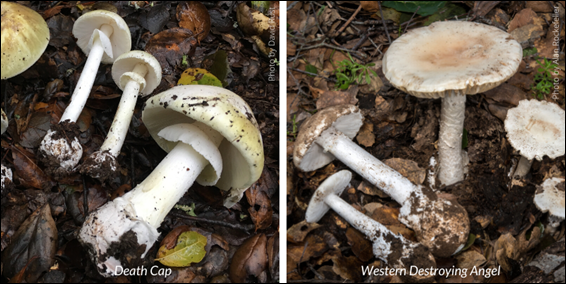
With the wet winter bringing an abundance of wild mushrooms to East Bay Regional Parks, officials issued an advisory warning that some can be lethal to humans and pets if consumed.
That includes the death cap (Amanita phalloides) and western destroying angel (Amanita ocreata), two of the world’s most toxic mushrooms. They contain amatoxins, molecules that are deadly to many animals.
“Symptoms may not appear until up to 12 hours after consumption, beginning as severe gastrointestinal distress and progressing to liver and kidney failure if treatment is not sought immediately,” East Bay parks officials stated.
These toxic mushrooms are mainly associated with oak trees and can be found growing anywhere oak roots are present. Pet owners should contact a veterinarian immediately if they suspect their pet may have eaten a toxic mushroom.
Collecting any mushrooms in East Bay Regional Parks is not allowed.
The death cap is a medium to large mushroom that typically has a greenish-gray cap, white gills, a white ring around the stem, and a large white sac at the base of the stem. Aside from oak trees, it has been found growing with other hardwoods.
The western destroying angel is a medium to large mushroom that usually has a creamy white cap, white gills, a white ring around the stem that can disappear with age, and a thin white sac at the base. It fruits from late winter into spring and is associated exclusively with oaks.
While these two mushroom types are responsible for most mushroom poisonings in the state, deadly toxins can also be found in Galerina and Lepiota mushroom species, which also occur in the Bay Area.
For more information about toxic mushrooms, visit ebparks.org/safety/trails/toxic-mushrooms.