
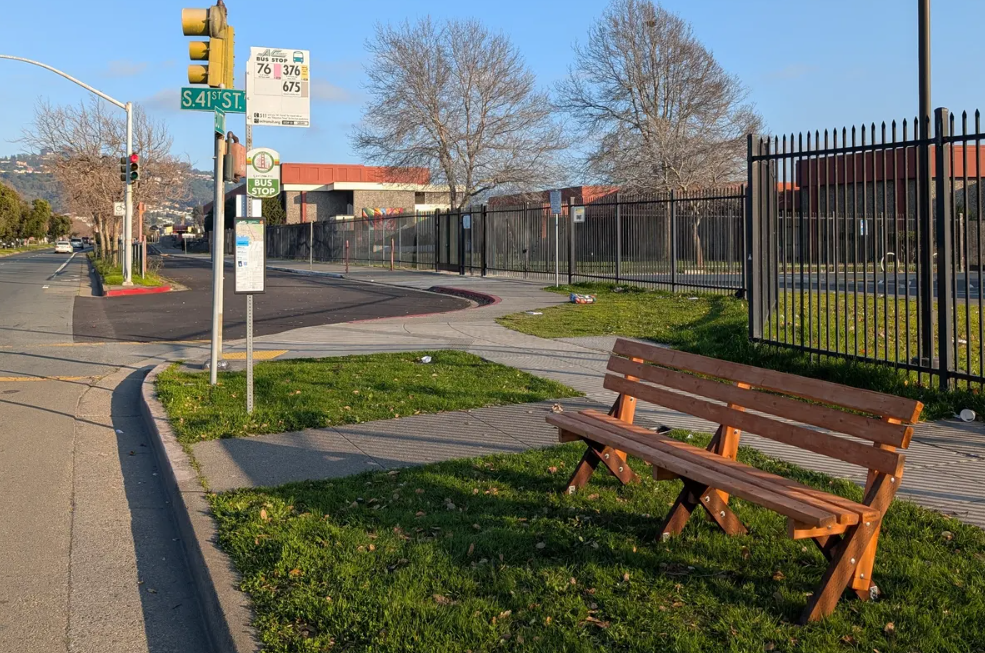
Residents want to build and install benches at underserved bus stops in Richmond—at no cost to the city.
During its May 27 meeting, the Richmond City Council voted to begin developing a city-sanctioned framework allowing community groups to legally build and install benches at bus stops lacking seating.
The initiative is driven by advocacy groups such as the San Francisco Bay Area Bench Collective (Bench Collective) and the Transbay Coalition, who have already helped to install more than 80 community-built benches across the East Bay, including seven in Richmond. These benches are mapped online on the Bench Collective website, which also provides updates on condition of the benches and the ability for the public to report problems with them.
The Council directed staff to incorporate bus stop benches into the city’s upcoming sidewalk policy update, and to create processes on permitting, design and installation standards for citizen-led installations. The city will also develop legal language protecting the city from liability in relation to the bus benches.
The new policy is expected to return to the City Council for further review by October 2025 and will be overseen by the Public Works Department.
Currently, Richmond has no formal process allowing residents to install benches. Meanwhile, hundreds of bus stops across the city lack seating. Community groups are trying to fill this gap, funding benches at a typical cost of about $150 each. Benches are assembled and installed by volunteers using a durable design, according to Carter Lavin of the Transbay Coalition, who presented the proposal.
Lavin stressed the importance of accessible seating in public spaces. While many assume seating is provided by transit agencies, the responsibility for bus stop amenities like benches and shelters often falls to local governments, he said.
“The City of Richmond has over 300 bus stops, and a significant number of them lack benches,” Lavin said, adding, “This is a matter of community care. It is physically uncomfortable to be standing for a bus, especially for those who are people with disabilities, for elderly people, for people who run errands, who have groceries—any number of people.”
Brian Harris, chair of the Richmond Commission on Aging’s transportation committee, spoke in support of the effort. A 22-year Richmond resident who relies on public transit, Harris described how the idea for citizen-led bench installations emerged from meeting Lavin at a transportation workshop months earlier. The idea eventually gained support from Richmond Councilmember Jamilia Brown and Richmond Vice Mayor Cesar Zepeda.
“When I saw we needed benches at our bus stop, I thought this could be an opportunity to bring something meaningful to Council,” said Harris. “I know what it’s like to wait at a stop and want to sit down.”
Several councilmembers and residents voiced support for the idea, noting its potential to improve quality of life for seniors, people with disabilities, and other transit-dependent residents. Councilmember Soheila Bana suggested the program could eventually be expanded beyond bus stops to include public parks and other community spaces.
City staff noted the importance of creating a robust permitting and maintenance framework and the need for clear guidelines on locations and approval processes.