
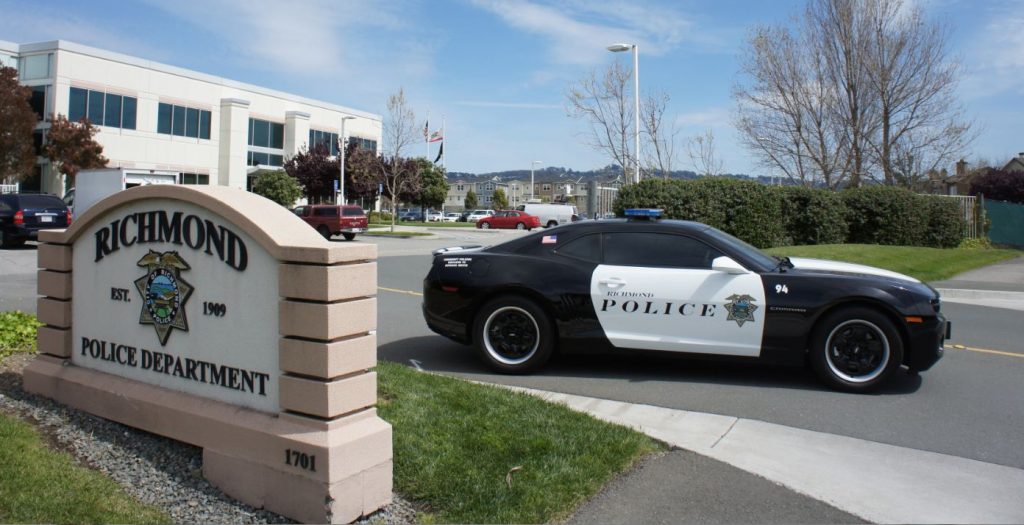
The good news? Crime was on a downward trend in Richmond in 2018, according to data provided by Richmond police Chief Allwyn Brown.
The not so good news? “Policing is a far less attractive field for job seekers than it once was,” making it difficult to fill both sworn and civilian positions, Brown said.
In his e-forum newsletter on Monday, Richmond Mayor Tom Butt published a year-end review that Chief Brown sent to him, the City Councilmembers and City Manager.
Below is his piece in full:
—-
General perceptions about Richmond’s safety have for decades been drawn from its murder rate. There were 18 murders during CY 2018, slightly up from the 15 homicides that occurred during CY 2017. But violent crime overall, decreased by 12% during 2018. We also realized significant decreases in firearm assaults, armed robberies, shootings, as well as other firearms-related crimes. At the same time, ShotSpotter activations decreased by 14%, which correlates to the 13% drop in calls received from the public reporting gunfire noise.
There were far fewer shootings and gunfire incidents throughout the city – significant because historically the mechanism of death in greater than 90% of Richmond murders has been firearm discharging. Also new and different, four of the 18 homicide cases investigated in 2018 show a direct connection to our homelessness realities; four cases involved an instrument of death other than a firearm; and fewer cases have links to ongoing gang feuds that can spark escalating, back-and-fourth retaliatory shootings that play out on public streets.
Crime overall was down 5% in 2018, and property crimes dropped 6%. Property offense more significantly affect the crime rate because they happen and are reported in far greater numbers than violent crimes (crimes vs. persons). Persistent crime prevention efforts can stop or discourage some of this kind of offending before it happens. Strong police community relationships matter when it comes to engaging, educating and empowering neighborhoods to take action around preventative measures.
COMMUNITY
Newer initiatives first tried in 2016 will continue with some fine-tuning this year. We are planning for two offerings of the Community Safety Academy, one in spring and one in fall. “Pound the Beat” activities will move forward with more coordinated participation of “Community Safety Ambassadors” to engage neighborhood residents around crime, prevention, and safety.
STAFFING
The Department confronted a number of rolling challenges related to both sworn and civilian positions in several key functions, mostly generated from a broader phase of workforce turnover affecting many sectors. Some of it made worse by the current truth, that policing is a far less attractive field for job seekers that it once was. We hired 7 police officers during CY 2018, but at the same time realized 11 police officer retirements and 4 sworn separations for other reasons. The staffing of key functions such as our Jail and Communications Center also experienced staffing instability over the course of the year.
With compelled overtime backfill obligations a reality early in 2018, we convened a work group with the RPOA to study the police officer Patrol schedule in use at the time, and several alternatives. Their representatives gave a presentation on their findings and recommendations to the senior leadership team. Their preferred new staffing model, an “11/80” schedule was agreed upon, and through a side letter of agreement adopted to their contract. It provides for better overlap coverage during peak evening call demands periods between the day shift and swing shift work hours, and four days off every other week, so also hopeful for helping to lessen employee fatigue and improve morale. It was implemented last week.
You may have noticed some uniformed police officers sporting facial hair. It’s part of a 90-day pilot program begun in November 2018 to measure community acceptance. Other police agencies in the region have recently changed their policies and allowed for the wearing of facial hair by their uniformed members. It’s a non-traditional look that has mixed reaction inside the industry, mostly tied to generation. The RPOA asked if we would consider this change for their members. We continue to study impact before making a final policy decision. Other places have cited help with recruiting younger police officers, greater community connection because cops look more human and approachable, and improved employee morale as positive momentum gained from making the change.
2019 OPPORTUNITIES & CHALLENGES
-
SB 1421 / AB 748 – This game-changing police transparency legislation carries with it a tremendous amount of increased staff time in order to be in legal compliance to requests for what has become public information. The RPD were early adopters and have equipped officers with body cameras since 2015. We intend to build capacity as we move forward and learn the full impact of these new responsibilities. The legislation makes it expressly clear that state will not be offering funding to offset the cost associated to these mandated requirements.
-
Police recruitments are ongoing and continuous. We’re exploring new ways to attract talented applicants and close our vacancy gap.
-
We’ll be continuing to build our 3-year strategic and succession plan to address present realities, that our working environment has experienced an accelerated pace of change over the prior three years, and that reality is not likely to improve greatly over the near term. We have 1) crafted a clear vision for the future – Our vision is to provide professional police services by partnering with our community to ensure Richmond is a safe place to live, work, and visit – and; 2) identified the top 5 values for our organization – Service, Leadership, Character, Development, Respect; as well as 3) identified the big issues that face the RPD going forward. We have transitioned to the next phase of work. In furthering our current mission, diverse work groups comprising a cross section of Department members and community are being convened to establish goals, and to create the strategies for advancement aimed at these organizational priorities:
-
Community Engagement and Crime Prevention
-
Addressing Crime and Disorder
-
Staffing and Succession Management
-
Employee Wellness and Development
-
We will continue to tinker with the police response to homelessness. The multi-disciplinary team approach is the current best practice model in addressing issues of homelessness and homeless encampments. We will increase our efforts working with the Contra Costa County CORE Team under a new agreement for additional treatment hours for Richmond. City Council recently approved an agreement not to exceed $100,000.00 to allow for this to happen. We will also continue to address neighbor concerns over increased theft and other disorder issues where homeless encampment emerge in proximity to neighborhoods. Anecdotal evidence suggests that there is some correlation.